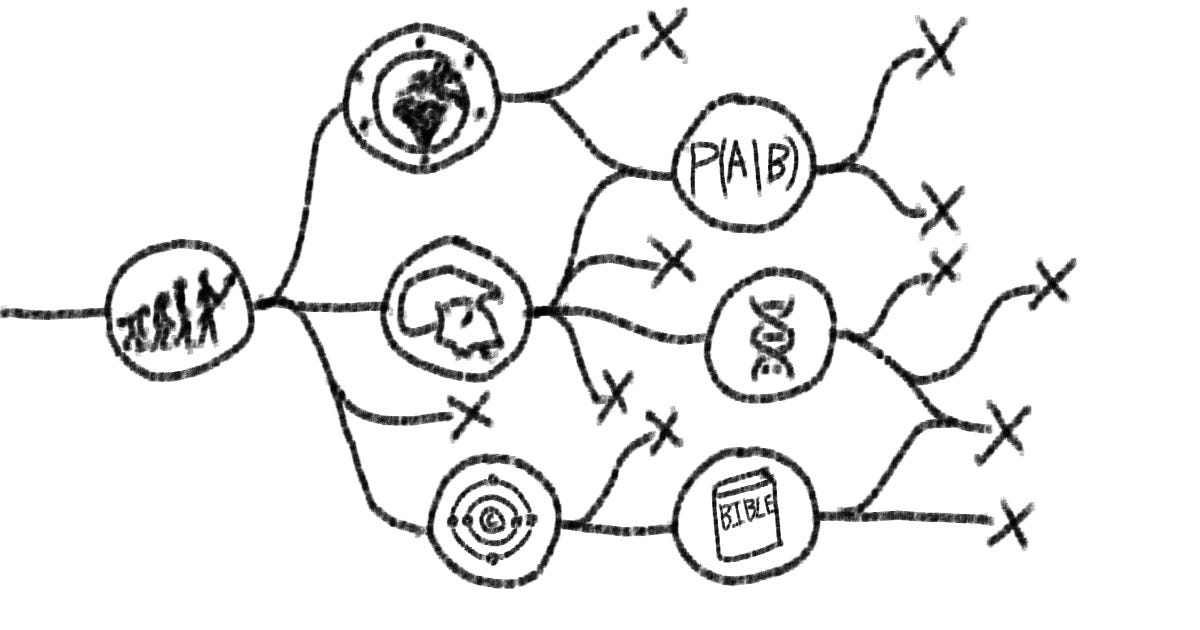
In retrospect, there is something quite fitting about the concept of a “scissor statement.”
Rationalists are fond of it; just hanging around them over the years, I’ve heard brought up as casual shorthand many times. I myself have used it! It was coined by Scott Alexander almost eight years ago in the short story “Sort By Controversial”. There’s something so amusingly Scott Alexander about it.
If nothing else, it makes for a pretty good story. Four thousand words, yet it’s a brisk, casual read. By turns amusing and disturbingly plausible. If I had to give a blind pitch, think Lovecraft by way of machine learning, stripping away all the gods and monsters without losing that spark of horror beyond comprehension. If anything, it elevates it.
Having long ago familiarized myself with the “twist,” I didn’t expect to find it this compelling on reread, yet I can almost say it holds up.
(And as occasionally happens with rationalist writing, when it speaks of AI, it sounds borderline prescient. Eight years ago means it was about a year before OpenAI would claim their GPT-2 model was too powerful to release, and remember, it took until around GPT-4 for the world at large to really start to appreciate what LLMs were capable of.)
But I don’t bring up that story to glaze its author. The story itself is almost irrelevant. The concept has gained a life of its own, much like “taking the red pill” is divorced from The Matrix (1999).
So, what is a scissor statement?
The idea’s simple and evocative. See, a lot of statements you’ll find yourself saying are innocuous, obviously true things we can accept without issue. But of course, there’s plenty of contentious things you know will start a fight.
A scissor statement is that rare chimera that seems totally innocuous…
…and now suddenly half the room is at your throat like one of those John Wick with ten guns pointed at him images used for engagement farming unpopular opinions on social media. (Incidentally, ragebaiting is exactly what Shiri’s scissor was invented to do.)
It is downright impossible to understand why someone would get mad at you after uttering a scissor statement. Isn’t this a settled matter we can all agree on? And on that point, they do agree! It’s obviously false!
The concept of scissor statements reflects a real frustration. Haven’t we all been there? You say something like “Christian bakers shouldn’t have to serve gay weddings” or “Colin Kaepernick should have knelt for the anthem” or “Brett Kavanaugh belongs on the supreme court regardless of those allegations, boys will be boys” and suddenly people look at you like you’re some kind of bigot!
(Real examples, by the way; in the fiction, these issues are all the product of scissor statements.)
But wait, have we all been there? If you have any familiarity with the issues, those statements seem pretty clearly contentious! Only ignorance could blind you to their implications, let alone their literal content. But okay, we aren’t born omniscient, maybe you’re one of today’s lucky 10k, and just didn’t know. You made a blunder, but you can learn and not slip up again.
Let me emphasize: scissor statements do not exist. This is not me being polemic — we’re talking about fiction, Scott made it all up, this is basically an SCP.
But again, the idea has outgrown the story that spawned it. I can search through rationalist chats and subreddits and easily find repeated references to this as a meaningful category of thing. (Sure, you can’t literally take the red pill, but you can wake up from the matrix, metaphorically. So aren’t there things that metaphorically behave like scissor statements?)
The natural conclusion is this idea caught on because people felt seen by the frustration and confusion it portrays.
But why?
To quote a climatic passage:
If you just read a Scissor statement off a list, it’s harmless. It just seems like a trivially true or trivially false thing. It doesn’t activate until you start discussing it with somebody. At first you just think they’re an imbecile. Then they call you an imbecile, and you want to defend yourself. Crescit eundo. You notice all the little ways they’re lying to you and themselves and their audience every time they open their mouth to defend their imbecilic opinion. Then you notice how all the lies are connected, that in order to keep getting the little things like the Scissor statement wrong, they have to drag in everything else. Eventually even that doesn’t work, they’ve just got to make everybody hate you so that nobody will even listen to your argument no matter how obviously true it is. Finally, they don’t care about the Scissor statement anymore. They’ve just dug themselves so deep basing their whole existence around hating you and wanting you to fail that they can’t walk it back. You’ve got to prove them wrong, not because you care about the Scissor statement either, but because otherwise they’ll do anything to poison people against you, make it impossible for them to even understand the argument for why you deserve to exist. You know this is true. Your mind becomes a constant loop of arguments you can use to defend yourself, and rehearsals of arguments for why their attacks are cruel and unfair, and the one burning question: how can you thwart them? How can you convince people not to listen to them, before they find those people and exploit their biases and turn them against you? How can you combat the superficial arguments they’re deploying, before otherwise good people get convinced, so convinced their mind will be made up and they can never be unconvinced again? How can you keep yourself safe?
This would resonate with you if you’ve repeatedly run up against this sort of interminable argument, ever felt a schism down the deepest axioms and definitions.
Or to put it bluntly, if you find you keep stumbling into rhetorical blunders — almost like you’re making a habit of it. I’d argue this utter incomprehension of controversy can only be so persistent in one’s experience if one has a lot of ignorance of others’ perspective (i.e. privilege), or if after stepping on a rake once, you fail to internalize the presence of rakes enough to look before you step.
There’s an interesting take on The Room (2003) which posited that the movie was a great portrayal of an abusive relationship — by accident, in spite of itself. Because the way it portrays the protagonist’s girlfriend as this inexplicably treacherous force tearing apart a man who never did anything wrong is deeply revealing — a self-portrait of how the world looks through a warped and ignorant perspective.
Take a closer look at that passage from the story quoted above. It’s inane, preoccupied with the statements themselves, with the words. It takes its own perspective for granted (trivially true) and all that opposes it are fleeting lies cooked up to support a trivial falsehood. Now saying this alone, I admit, would just be nitpicking.
But the words you hear are just a tail, not the dog wagging it. They are the output of another perspective and worldview. People are penetrable to analysis; you can understand them!
I called this passage inane, and I mean that in a etymological sense. It is empty, vacuous, starved of meaning. Where are the stakes? Statements about gay weddings and systemic racism protests and rape culture are not trivial. Maybe they seem that way if you don’t care, if you uttered your “scissor statement” heedless of its implications.
But these thing matter. Have your critics “dug themselves so deep basing their whole existence around hating you,” for no reason other than you uttered a trivial statement, or did that “trivial” statement naturally hook into a prefigured, entrenched system of conflict you were already unwittingly a part of?
(One can imagine a very different, more conscious horror story, where instead of the big reveal being that banal trivialities can tear the world apart, you find that speaking certain words reshapes the world in ways you don’t understand, culminating in a grand reveal that wielding this strange power required that you be at birth drafted into a power struggle you knew nothing about and never asked to be a part of.)
A scissor statement isn’t just someone disagreeing about something you think is self-evident. To believe in even the weak, metaphorical existence of “scissor statements” requires dumbfounding yourself about the source of your disagreements, reifying it into the fruit of some magical, malign influence. In the story, scissor statements are deployed like weapons, inflicted upon us by an unknown faction to manipulate our world’s politics.
It’s like all the feminists arguing with you are pawns in service to some nefarious agenda…
There’s a distinct rhetorical effect to calling something a scissor statement — scissors cut symmetrically. It’s neutral, agnostic, blaming both sides equally. If you call something a “ragebait” or “dogwhistle”, there’s an implicit accusation of bad faith. If you call something “misinformation,” you acknowledge that one side is right.
If you call something a “scissor statement”, which side you end up on feels as arbitrary as whether you have the gene for tasting cilantro.
Politics is an alien force acting on you, not a system working through you.
Rationalists were well-primed to accept this sort of framing. After all, politics is the mind-killer. It’s this insidious evolutionary glitch able to flip off the brains of even high INT rationalists and turn them into “slogan-chanting zombies.”
Earlier, I wrote that believing in a scissor statement requires a deep ignorance, or a skill issue in the face of opportunities to learn more. But there’s a third possibility. That the incomprehension here is purely rhetorical, a deliberate dumbfounding.
You treat these disagreements as if they were a geas magicked up by Shiri’s scissor generator because you are smarter than such petty disputes, you see through it. Alas, some people are just getting helplessly mind-killed by trivial words.
If I had to sum it up in a single word, the concept of a scissor statement is so… infantile.
Is this not a child’s understanding of the world? There are certain no-no words that make the adults punish you and all the other kids start being mean to you. It’s all so unfair!
Why is it this way? IDK, doesnt make any sense, the world is weird and scary sometimes.
Maybe it strikes you that I’m being a little too hard on Scott for this one story written almost a decade ago. Sure, the concept has taken a life of its own, but isn’t that because it’s a useful concept? Nothing wrong with having a compact little allusion like this in your back pocket. Not every word word is chained to its etymology.
Indeed, while writing this post, I was constantly struck by the thought that, well, I’ve seen what debating conservatives is like, there really are people that are fractally wrong on so many issues.
Whatever his follies, at the end of the day Scott isn’t a terrible writer and isn’t devoid of insight.
The idea sticks with people because it kinda do be like that. Hot button issues sometimes are simply baffling.
Since writing this post, I’ve had a few arguments in chatrooms about it. And I find to defend the concept of a scissor statement, you have to retreat from what it literally is.
When the first scissor statement is discovered, two engineers get into an argument over it, can’t reach any agreement, drag in their coworkers, then escalate to the boss, and they proceed to fight for hours until the dissenters get fired. They go on to sue the company, then the boss drives over to beat one of them up, getting himself arrested and losing the whole company.
These people literally invented the scissor generator and could not see past the schisms it carved. It’s like some mage cast ⸢Frenzy⸥ on them.
But isn’t this just hyperbole, evocative exaggeration? Sure, there aren’t any actual power words that can mind-whammy you into escalating, inescapable aggro. But the dynamic of mutually dumbfounded conflict exists, doesn’t it? Shouldn’t we have a label for it?
Nevermind that the symmetry of the scissor so rarely bears out in practice — the privileged easily get blindsighted by the protests of the oppressed, but that doesn’t mean the oppressed are remotely surprised. But maybe not every scissor cuts along such clear-cut, entrenched lines.
But “the dynamic” is vacuous, question-begging. Yes, scissor statements do exist if you strip away all of the wrongheaded bits until you get the parts that must necessarily map onto reality.
The thing about false insights is that they are real and specific observations, but the real parts aren’t specific and the specific parts aren’t real. “Having a label for it” is a dangerous thing, because labels impart framing. There’s connotations and implicit judgments in every label — they aren’t neutral windows into reality.
It happens sometimes in real life, rarely, that a disagreement starts small and snowballs bigger and bigger, in an almost analoguous fashion — but crucially, there is no spell that can consistently turn “trivially true” statements into vendettas so intense you’ll get arrested for assaulting them over it. The ontology of how truth and belief formation works would have to be fundamentally different to ever allow Shiri’s scissor to function.
Consider . Are they real? Some ideas are hard to describe or remember, but there isn’t any idea that can innately erase all records of itself, whether stored on brain or photo or computer file. That is a purely conceptual effect at odds with the mechanics of how the physics of this universe works.
Is it unfair to raise the bar of “scissor statement” so high nothing can ever satisfy it? I often find myself arguing that your terms shouldn’t be made useless by definition. We already have a word for “nothing”, so if you have a choice between coining a synonym for the empty set and including anything at all, it’s preferable, practical, to gesture at something real.
But my problem, with both “antimemes are real” and “scissor statements are real” is that this is magic. You are trying to describe the world with magic. Even if you define your magic as only strictly specifically the effects that are actually real, I think the impulse and effect of reasoning magically is cognitive distortion.
Scissor statements suck as an idea to the extent that it reifies your ignorance; it shrugs and says oh well, what can you do.
To call it a scissor statement is foreground the words themselves, and elide all else. Does it map onto reality? Can you understand the other position? Did you simply make a mistake? No, the scissor triggered and now everyone is forever fighting Just Because.
But you can rightly accuse me of spitting all this vitriol without justifying where I’m really coming from. Are rationalists — is Scott — so ignorantly centrist as I imply? This is a rant, and I think it mainly makes sense to those already read-in on the issues I’m dissecting: if you already know and dislike Scott, or rationalists as a whole, or do like them but want to hear out what critics have to say.
And not everyrat who heard me out found this argument convincing. I gesture vaguely at connotations and framing, but nothing substantial enough that we ought to discard the concept of a scissor statement wholesale.
Cards on the table, I make this critique chiefly because I’m already convinced Scott’s work is unsalvageable and rationalists are little better.
If Scott were brilliant and rationalists were as a rule virtuous, yet somehow they yielded a textually identical concept of scissor statement (emphasis on somehow, because the odious centrism is a tad bit baked in) then there’d be no real force behind what I’m saying here.
Imagine a house caught fire and blew up, and it was so intense you can see scorch marks on the next house over (it’s a suburb). I walk over, take a picture of that, and post it saying, “Look at this! What a fire, huh?”
The fire was so bad because the property blew up, and the scorch-marks simply underscore that fact. If the house blew up without leaving the scorch-marks, it’d still be bad, and if it turns out it was actually just a stray firework that went off and nothing else was destroyed, then the scorch-marks have little significance.
I find it kinda neat that you can look at this tiny part of Scott’s corpus, and still see the marks of its origin. Dumbfounded, ignorant, and classically centrist. But this only works because it’s not the only evidence thereof — it would be downright unsound to believe what I’m saying based on this post alone.
So why is Scott so deplorable to me?
After all, this was just a piece of fiction, and you cannot extrapolate from an unreliable narrator to divine the author’s true beliefs.
Except. Scott has written millions of words of blog posts over his prolific career. So we can just ask: what does he actually think about political division?
One of Scott’s most influential essays is “I Can Tolerate Anything Except The Outgroup”, which I’d go as far as to call a foundational piece in the rationalist understanding of politics. It’s influential even outside that niche — figures like Sam Altman praise it.
It’s from 2014, so it’s very old work, yet his modern substack puts it as #3 on the list of his articles to start with.
Consider this choice passage:
Compare the Nazis to the German Jews and to the Japanese. The Nazis were very similar to the German Jews: they looked the same, spoke the same language, came from a similar culture. The Nazis were totally different from the Japanese: different race, different language, vast cultural gap. But the Nazis and Japanese mostly got along pretty well. Heck, the Nazis were actually moderately positively disposed to the Chinese, even when they were technically at war. Meanwhile, the conflict between the Nazis and the German Jews – some of whom didn’t even realize they were anything other than German until they checked their grandparents’ birth certificate – is the stuff of history and nightmares. Any theory of outgroupishness that naively assumes the Nazis’ natural outgroup is Japanese or Chinese people will be totally inadequate.
And this isn’t a weird exception. Freud spoke of the narcissism of small differences, saying that “it is precisely communities with adjoining territories, and related to each other in other ways as well, who are engaged in constant feuds and ridiculing each other”. Nazis and German Jews. Northern Irish Protestants and Northern Irish Catholics. Hutus and Tutsis. South African whites and South African blacks. Israeli Jews and Israeli Arabs. Anyone in the former Yugoslavia and anyone else in the former Yugoslavia.
So what makes an outgroup? Proximity plus small differences. If you want to know who someone in former Yugoslavia hates, don’t look at the Indonesians or the Zulus or the Tibetans or anyone else distant and exotic. Find the Yugoslavian ethnicity that lives closely intermingled with them and is most conspicuously similar to them, and chances are you’ll find the one who they have eight hundred years of seething hatred toward.
What an odd thing to say. But I suppose the idea of a “trivially true” statement causing the United States to erupt into civil war is a pretty plausible premise for a story, if you’d describe opposition to National Socialism essentially the same way.
Scott Alexander has been on my mind a lot the past few weeks. Last month, I had the pleasure of helping proofread The Infantile Sepsis, a series of blog posts diving into some pitfalls of rationalist thought more deeply. Our pal Scott features heavily in it.
That is the resource I would point you to if you’d like to learn more about the issues with Scott’s work.
As I publish this, the series is releasing piece by piece, but I waited till now to mention it because there’s about twenty posts already out, making it a substantive read at this point.
In particular, if you want to read someone tearing apart the idea that the fucking holocaust was the product of the “the narcissism of small differences,” as well as the myriad other claims made in that sprawling, incoherent “outgroup” essay, there’s a eight post subseries dissecting that trashfire alone.
If you read this far into my post, you’d definitely get something out of The Infantile Sepsis, even if you aren’t a rationalist, even if you hadn’t heard of Scott Alexander till now. It’s quite an informative and dare I say entertaining read. I’d love it if you gave it a look.